
Why US markets are driving the outlook for UK interest rates
UK interest rates may depend less on the Budget than on US inflation, Treasury borrowing and energy prices
The value of investments can fall as well as rise and that you may not get back the amount you originally invested.
Nothing in these briefings is intended to constitute advice or a recommendation and you should not take any investment decision based on their content.
Any opinions expressed may change or have already changed.
Written by Daniel Casali
Published on 20 Oct 20263 minute read

As Chancellor John Healey prepares to deliver the Budget on 28 October, investors are once again focused on the UK's public finances. Rising borrowing costs and mounting spending pressures have left the Treasury with little fiscal headroom, particularly with UK 10-year gilt yields around 5.5%, the highest level in nearly 20 years.1
For some, the name Healey may evoke memories of Denis Healey and the IMF crisis of 1976. Today's challenges are considerably less severe, but the underlying requirement remains the same: maintaining the confidence of investors in the gilt market.
Yet focusing on Westminster alone risks missing the bigger picture. While domestic fiscal policy matters, many of the forces now shaping UK gilt yields and Bank of England (BoE) interest rates originate abroad, particularly in the US.
Why America matters
Gilt yields rarely move independently of the US Treasury market. At roughly $40 trillion, Treasuries are the largest bond market and serve as the global benchmark for sovereign borrowing costs.2 As such, shifts in US growth, inflation and borrowing expectations ripple across bond markets worldwide.
History illustrates the point. The 2007 financial crisis began in the US before spreading globally. Even the 1976 IMF crisis reflected more than Britain's domestic weaknesses. Washington encouraged an IMF solution rather than a direct US rescue, highlighting how developments beyond Britain's borders can influence its economy and financial markets.
In short, external shocks have often had significant effects on UK markets, alongside domestic events such as the 2022 mini-budget. The same principle applies today. While the Budget may influence short-term sentiment, the broader direction of gilt yields may depend more on Washington than decisions in Westminster.
Energy prices remain a risk
America's influence extends beyond bond markets. It also reaches the UK through foreign policy, energy prices and inflation.
Recent tensions in the Middle East have pushed energy prices higher, creating another source of inflationary pressure. While crude oil prices remain below previous peaks, diesel prices have surged. This matters for the UK, where diesel powers much of the transport, logistics and agricultural sectors.
Since the UK is heavily reliant on global supply chains, it remains particularly exposed to imported inflation. Concerns have also emerged over the possibility of restrictions on US diesel exports, underlining how decisions taken in Washington can quickly affect prices elsewhere.3
Brent crude oil is more than 50% higher than a year ago, suggesting further upside risks to headline inflation in 2027.4 If businesses pass higher import costs on to consumers, the BoE may be forced to keep interest rates higher for longer, or tighten policy further. Against this backdrop, geopolitical shocks and US policy decisions can have a greater influence on UK inflation and interest rates than many domestic policy measures.
UK headline CPI inflation and Brent crude oil (% yoy)
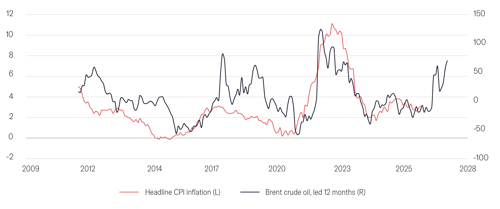
Source: LSEG Datastream/Evelyn Partners. Data as at 15 Oct 2026
The investment takeaway
Rising gilt yields have already eroded much of the government's fiscal headroom, limiting Chancellor Healey's options.
The Budget will undoubtedly generate headlines. Yet investors seeking the most important driver of UK interest rates could also look beyond Westminster. US inflation, Federal Reserve policy, Treasury issuance and global energy markets could play a significant role in determining the future path of gilt yields.
Westminster may dominate the political and fiscal debate, but US developments are an important influence on the outlook for UK interest rates.
Risk warning
The value of investments can fall as well as rise, and you may get back less than you invest. Past performance is not a reliable indicator of future results. This article is for information only and is not personal financial advice or a recommendation to buy, sell or hold any investment.
Sources:
1,2,3 Evelyn Partners/LSEG 15 Oct 2026
4BBC, US pressures Europe to release diesel reserves as Trump threatens export ban, Oct 2026